Keeping it Real
 My radio placement was over the other side of MediaCity with the Real and Smooth network. For a radio fan like me this was a great to work in a news hub that served a network of three stations, Smooth Radio (national), Real Radio (North West) and Real XS (Manchester). As is the unpredictable nature of news, during my time on placement a lot stories that got massive national media coverage broke on our North West patch.
As you’ll know from my post about my placement with BBC North West Tonight, this is a reflection of the work I did on placement rather than a recount of the news – you can access that in many places on the web, I’ll link to the stories. In these posts, I want to offer a different perspective through my eyes as a reporter…
MICHAEL AND HILLARY BREWER SENTENCED FOR SEXUAL ABUSE AT CHEETHAM’S SCHOOL OF MUSIC
I got my first taste of a media frenzy outside court after the sentencing of Michael and Hillary Brewer, who were charged with sex offences, mostly occurring while he was a teacher at Cheetham’s School of Music in Manchester. This case had got attention because of of the victims, Frances Andrade, took her life during the trial. Atmosphere outside of court was tense as the media eagerly awaited the statement from the Crown Prosecution Service.
The cameras were in place well before but radio reporters have to think quickly to get in a good position when speakers come out so that they can be in range to get good quality audio on the microphones. I did well to get right at the front, which not only meant that Real Radio got good brand placement for the cameras but also that my hand was seen on all the TV news channels that day. I’m now in a strange situation where my purple coat is more famous than I am!
DOG ATTACK THAT KILLED JADE ANDERSON IN ATHERTON
 No matter how much training you have beforehand, nothing can prepare you emotionally for some of the stories that you will have to cover as a journalist. The day started out like any other, I was out vox popping a light story in the morning but then I got the call to go on to Atherton, near Wigan, to cover the story on Jade Anderson – a 14 year old girl who had been mauled to death by pitbull type dogs. Like the flick of a light switch, the tone of the work had changed and was now incredibly sombre.
When I got to the crime scene I had never heard a silence like it; despite there being so much activity from media attention to people coming to pay their respects – there was no noise to be heard on the estatem other than a lone dog barking in the distance. Very haunting.
STEPHEN SEDDON GIVEN A LIFE SENTENCE FOR MURDERING HIS PARENTS
I had been following the Stephen Seddon trial while working with BBC North West Tonight and was in court reporting on his sentencing. Sedddon was found guilty for murdering both his parents. The judge, Mr Justice Hemblem, said the motive was for their inheritance money. Seddon’s sentence also included attempting to murder his parents earlier in the year by driving them into a canal.
Courtrooms feel very theatrical, maybe I have been watching too many legal dramas, but the atmosphere really was intense. To look directly at a man who has been sentenced to life imprisonment from the press box is a rare opportunity to have. It’s dramatic enough hearing about such cases on the news, but to actually be there to hear him sent down in person is something else. I was absorbing the atmosphere of the court proceedings happening around me while scribbling down notes as fast as I could – no recording devices are allowed in court. However, the judge’s words were so powerful, alongside Seddon’s own outbursts and last pleas of innocence, that I can still remember much of what was said in there verbatim, even now.

I covered lots of stories during my time on placement with Real, from the abolition of Legal Aid in some situations to Stockport being voted the second happiest place to live in Britain. (Yes, really!!) By far those that I’ve mentioned in this post are the news stories that stick in my mind most potently though. It was a joy to work with the team whose bulletins I’ve listened to for many years on a network of stations that I am a fan of. Not only was that an amazing experience in itself but I learnt so much while I was there too and my copy writing skills are well up to broadcast standard. Hearing scripts I had written be read in bulletins was amazing – I loved working in such a buzzing newsroom! My placements have given me the taste of what working life will be like when I graduate from my masters and I take all those valuable experiences forward with me now I’m applying for freelance work.
BBC North West Tonight
 When I tell people I did my TV work placement with the BBC North West Tonight regional news programme I usually hear something like “but we didn’t see you on TV!” That’s beside the point really; screen time on any TV programme only accounts for what viewers see. There’s a whole team working hard behind the scenes to get content to air as smoothly as possible – I loved being part of it!
There would be so much to mention about time working on the programme, and alongside so many talented journalists, but then it would become more of a epilogue than a blog post – so this will have to be a whistle-stop tour. (In no particular order, terms and conditions apply… Oops! Didn’t need the bit about T&Cs!) Here we go…
HEART SCREENINGS IN MEMORY OF JOHN MARSHALL
Having footage I shot myself air on the North West bulletins during BBC Breakfast was an honour. My footage was shown after interviewing the family of John Marshall, who died suddenly from an undiagnosed heart condition 18 years ago. His family were holding a screening session at Edge Hill University as part of their campaign for heart screenings to become more widespread and to raise awareness of heart conditions affecting young people.
NEW DRUG APPROVED TO FIGHT BREAST CANCER
A drug called Perjeta had been granted licence for use in Europe; it prolongs the lives of some breast cancer patients by over 6 months. Although not yet available through NHS treatment, the drug has been trialled by The Christie in Manchester – I was going to interview a doctor about their findings. Case studies are what illustrate news best and when I got there I was able to talk to someone who had experience of using the drug. As this was all very spontaneous I was about to do my most emotional interview to date with no preparation! This is where my initiative journalistic skills came in and I was able to come back to the newsroom with poignant footage used in a big screen presentation by NWT health correspondent, Nina Warhurst.

APPEAL TO FIND ANDREW JONES’ KILLER
Andrew Jones was killed in 2003 after injuries sustained after falling to the ground from a single punch. 10 years on and his parents, Christine and Andy, were appealing for anyone with information to speak out. I interviewed them at Merseyside Police Headquarters ahead of their weekend vigil. I found out the embargo had been lifted on this story while there and after relaying the messages to producers my work featured in Dave Guest’s top story for the lunchtime and evening programmes.
 THE ARCHBISHOP OF LIVERPOOL’S RESIGNATION
One of the last official duties that Pope Benedict XVI had to approve was the resignation of Liverpool’s Archbishop Kelly. I spoke to him at the Metropolitan Cathedral in Liverpool and helped film one of his last masses in tribute to the outgoing Pope that featured on the late bulletin.
COMIC RELIEF
It was a privilege to be on placement with the BBC during Comic Relief . I particularly enjoyed helping Carol Lowe film her report on how some of the money was being used in the North West at Stick ‘n’ Step. A charity helping children with Cerebral Palsy, in Wallasey. I also got to shoot footage of what was happening to fundraise around MediaCity. Particular highlights of mine were the Bake-Off, Harlem Shake out on the piazza and the Zumba-thon in Liverpool, all of which I filmed and were shown in the North-West opt-out during the evening’s main Comic Relief programme.
LAUNCH OF MANCHESTER INTERNATIONAL FESTIVAL 2013
 Eno Eruotor and I went to the press launch of this year’s MIF, we heard about what was to come in the festival, which featured an appearance from Shakespearean actor Kenneth Brannagh! He wasn’t giving any interviews (and at that point he didn’t even know I was in control of the lighting!!) but we did speak to one of my favourite actresses, Maxine Peake. She gave me a bit of competition for being NWT’s biggest fan too!
Sadly, I can’t cover everything that happened on my placement or mention everyone, but those are the main things I talk about when people ask me about my placement. Thanks to all the NWT team for making me feel so welcome, trusting me with their content and giving me a TV placement I will never forget!
My next blog post will be about my radio placement with Real Radio… Stay tuned!

Looking through a lens at the Boston Marathon
Breaking news can cause a surge in social media visits as people all over the world feed their hunger for the latest information. This applies to any major news event or tragedy but I’m going to focus on the most recent, which is the aftermath of the explosions at the Boston Marathon.
I looked at social media myself to see the updates and near enough every tweet contained something about Boston. Tributes and opinions alike flooded my timelines – but instead of moving me I found it unsettling.
Trying to squeeze my thoughts into 140 characters, I posted this tweet:
https://twitter.com/katybooth/status/323916002624688128
I had such a big response, and a wave of new followers off the back of it, that I wanted to expand here in my blog. I have a problem with the voyeuristic images that I was bombarded with, whether I wanted to see them or not. Apparently, as news consumers, we ‘need’ to see images of devastation like that. Fair enough, the blasts were shocking. Do we really need to see images of the injured at what is perhaps the most vulnerable time of their lives?
In my view, ethics should come before sensationalism. In the UK, the law states that people should have a “reasonable expectation of privacy” and this would be most applicable in times of extreme tragedy and heartache. Yet, I could see the torture on the faces of people whose legs had been blown off being stretchered away. I doubt they had given their consent to that. It brings up the debate as to whether a person surrenders their right to privacy for being involuntarily caught up in a news story for the sake of ‘good pictures’ or whether their right to privacy should be respected by journalists.
Just because technology makes it available doesn’t necessarily make it right. Maybe it’s because our culture is used to the blood and gore seen in films and video games – but this is real life. I think it reflects our sadistic society; devastation could still be conveyed by censoring someone’s identity, not ideal but it’s a compromise.
It’s not to say I agree with it, but I can understand why news corporations broadcast and print these contentious images. The knock-on affect of this is that the images can then be copied and manipulated by the general public and posted to their social media profiles, on the likes of Twitter and Facebook. In their defence, many may feel it’s a tribute to post their blessings next to a photo of a wounded runner. Personally, I find it disrespectful and an invasion of privacy into the life of someone they have never met.
Anyone with a camera and a wi-fi connection can now be a reporter, but perhaps more worryingly, is that anyone with a keyboard and an opinion thinks they can be a citizen journalist. Although, there is something fundamentally wrong in that view because any credible journalist knows it’s their duty to report, rather than speculate, about what’s happening. The people on social media trying to be citizen journalists can offer no more insight than the next person sat gazing gormlessly at a computer screen can. It’s the reporters at the scene who can relay the accurate information – chose your sources wisely.
I’m not condemning the support that the Internet can offer, the tributes to the victims of the Boston blasts were touching. However, this has a flip side; the Internet, particularly social media, is littered with people’s opinions that mean nothing. I’m all for freedom of speech as long as it’s informed and respectful – otherwise, why waste your breath?
Roving reports from MediaCity…
 Ever since I can remember, I’ve always wanted to work in the media industry and have been fascinated by the broadcast side of things. Starting out on student media laid the foundations for my radio work and when I graduated I was fortunate to earn a place on ITV’s Runner Pool. I was based in Leeds and at Granada working as a production assistant for factual / entertainment programmes and got a real buzz from working in such a fast paced environment. Since enrolling on UCLan’s Broadcast Journalism masters I’ve been able to create content for all broadcast mediums, as well as learm a new journalistic skill. Now I’m looking forward to beginning the courses’ BJTC work placement period with the BBC at MediaCity.
Any big change prompts me to get wistful about where it all began. I can remember vividly where my inspiration to work in media comes from – it goes back to when I was in primary school. My parents’ friends, Mavis and Laurie, owned a company that got commissioned to make TV sets for lots of different programmes. At the time they’d just finished the set of a new Sooty show for Blackpool Pleasure Beach. You can imagine my excitement when they said I could see Sooty’s set… Come to think of it, I’d probably still get excited about that now!
It was an amazing experience to see the sets I’d seen on TV in front of my eyes. As we walked along the shopfloor I did get to see Sooty’s new lodgings, alongside a fascia from Coronation Street’s Rovers Return and Gordon Burn’s new North West Tonight desk. When the show got re-branded there was the desk that Laurie had made on the screen! I’ve been a fan of NWT ever since. I love regional news and have watched the programme for years, so I think it must go back to that moment.
It’s been great to have been taught by a producer and cameraman from NWT while at UCLan. The packages that I’ve filmed for our news days are all available for you to watch on my YouTube channel. To quote Blue Peter – here’s one I made earlier! It’s my latest TV report about the Book Cycle project in Wigan…
More of my reports are available my YouTube channel: youtube.com/katybooth
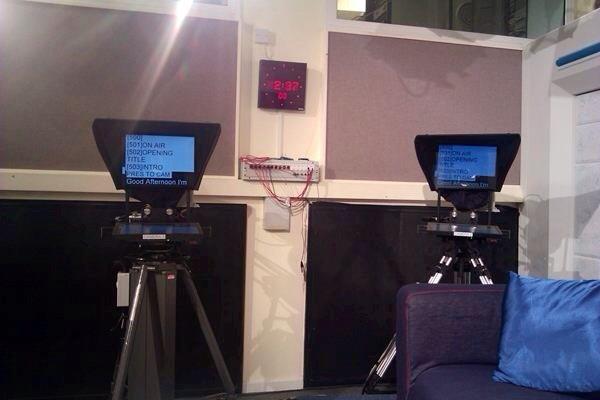 I’ve enjoyed both our UCLan radio and TV news days, where we got the chance to broadcast news bulletins for both mediums as well as creating web content. I already had a lot of radio experience prior to joining the course but it’s definitely sharpened my skills and the voice training has been beneficial – especially in getting, what the vocal coach described as, my “lazy tongue” into shape!
I learnt new skills as well as lots about myself with our TV news days too I can now self shoot my own reports. This was an ambition of mine and I’m glad that I can say I’ve achieved this and can put it on my CV. Having made my own videos for years with a camcorder it’s been good to learn how to professionally edit reports too. These are all skills that I will be using on my work placement with BBC North West Tonight. The news desk that I saw and even the studios where the programme broadcasts from have changed over the years but I’ve watched the programme throughout, so it will be a privilege to spend my placement with the NWT team.
Maybe one day I’ll be able to sign off with my own standard out cue, but until then here’s a photo from our course trip to MediaCity…
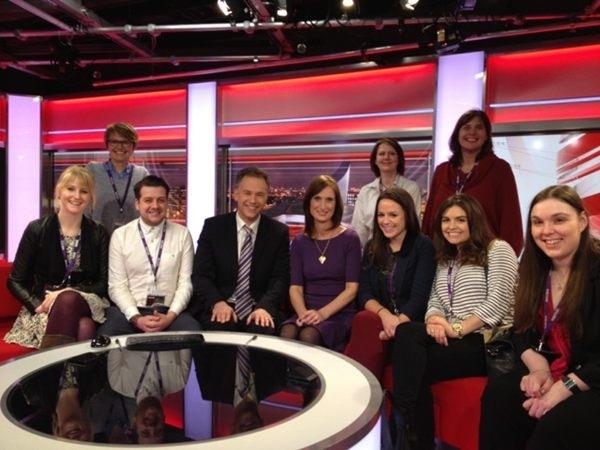
The post-grads on our trip to BBC North West Tonight with Roger Johnson and Annabel Tiffin
2012 – A look back on my year…
As we begin a new year I’m looking back on what made 2012 so memorable for me. There have been far too many things to list in one post, so I’m going to do a Top of the Pops style look back on my top three milestones of last year. (If you want to read my blog’s annual report then Click Here.)
3) Chilled Pure on Pure 107.8 FM
 I was listening on the day that Pure 107.8 FM was launched across Stockport in 2005 but would have never imagined (bad choice of word!?) that my voice would be on its airwaves. Now I have my own slot on the radio station that broadcasts to my home town and it’s a dream come true for me. I’ve been involved with the station in many different ways over the past three years – from wearing the panda suit to the end of year parties – it’s been great!
To be given the chance to present the Chilled Pure slot on the station was a great honour for me, not only because I appear on the schedule alongside seasoned broadcasters, but also because I get to play the easy-listening music that I’m passionate about.
I loved broadcasting on Christmas Eve into Christmas day; it was the icing on the cake for me to be on “Santa Watch” across the Stockport sky last year. I look forward to presenting more Chilled Pure weeknights from midnight in 2013!
2) Making Mental Health Positive
 It might seem obvious but one of the best things about community radio is that it puts you in touch with some of the wonderful things that happen in your local area. Through my Chill Room show on North Manchester FM a listener, Dawn Perry, got in touch to tell me about her Making Mental Health Positive campaign and during 2012 I’ve enjoyed getting involved with this.
I’m the campaign’s media co-ordinator and part of the admin team that moderate the Facebook page, which acts as an online peer-to-peer support network. To see content featured on my radio shows have an impact in the community as well as a positive affect on people’s lives is wonderful. The campaign’s monthly meet and create events have been a success at The Lowry last year and these are continuing in 2013. With the campaign’s member count growing every day we go into the New Year outreaching to more people than ever.
1) Broadcast Journalism at the University of Central Lancashire (UCLan)
The turning point in my year came in September when I enrolled onto the Broadcast Journalism masters course at UCLan. Journalism had been a career path I’d considered for a long time but taking the plunge and starting the course was the best decision I made in 2012.
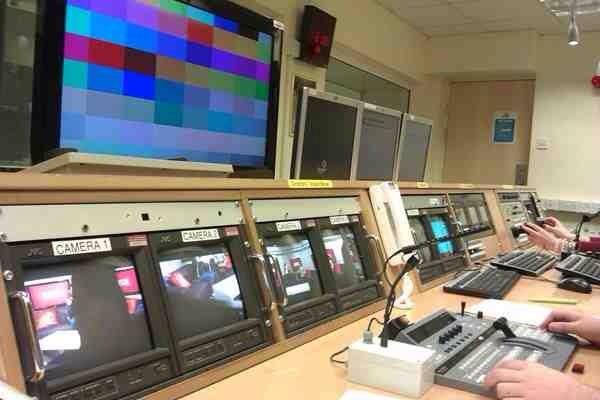 My family’s roots are in Lancashire so I’ve enjoyed exploring Red Rose County and getting to know the people in the area, especially in a year as special as the Preston Guild. Being a broadcast journalist means that I’ve had the opportunity to meet people and try out things that I would’ve never had chance to otherwise. I love the spontaneity of it; no two days are ever the same. I’ve met the man who designed a Preston CityScape out of MDF wood, sparred in a Blackpool Boxing Gym as well as eaten a battered mince pie…. and that’s just some of the places where my reports took me last year!
When I write my review of what a year 2013 has been, I will have graduated. It’ll be interesting to see what I’ll be doing then and look back at how I got there. I’m dedicated to my career and determined to achieve my dream of becoming a broadcast journalist. I know this year’s going to be hard work but it will also be exciting. I hope you’ll stay with me and follow my blog throughout 2013.
To be continued…
Global vs GMG – not such a ‘Smooth’ takeover?
Global’s takeover of Guardian Media Group’s (GMG) stations will change the UK’s commercial radio landscape as we know it. Until a decision is made on March 27th about the future of the stations involved, speculation will continue as to what will happen next. Direct competition is between each network’s stations with similar demographics: (GMG stations listed first, with the genre of music they play in brackets.)
– Real vs Heart (Adult Contemporary)
If the takeover goes ahead consensus seems to be that Real stations will turn into Heart, which could then follow Capital’s example of syndicated shows across the network. This looks likely now Real’s own output is beginning to be syndicated, suggesting the transition to Heart would be smoother (pardon the pun!)
– Real XS vs XFM (Rock)
Real XS has had a tumultuous time of late – the re-brand from Rock Radio wasn’t liked by listeners. The station plays automated rock music other than at peak times (breakfast and drive), so a merger with XFM seems likely.
– Smooth vs Gold (Easy Listening)
Here’s where it gets interesting; it’s not as clear-cut what may happen to Smooth Radio. If this was a boxing match Smooth would be a heavyweight and Gold would be featherweight, they’re not as comparable as the genre of music they play might suggest.
A better way to compare stations is through RAJAR statistics, radio’s equivalent of TV ratings. A lot of spin can be put on these figures but I think ‘Listening Hours’, the total number of hours each station is listened to each week, gives the best indication of station size – especially as radio is all about listeners.

Data taken from last quarter’s RAJAR statistics. Total Listening Hours listed in hundreds.
You can see there are more Gold stations than Smooth but the areas that they cover are more concentrated, so their reach is smaller. Even though both groups of stations are available on digital multiplexes, analogue frequencies are still important. Smooth has the advantage of an FM presence here. Gold stations are only available on medium wave, which broadcasts at a lower audio quality.
These factors, along with higher listening hours, mean that Smooth has a stronger brand identity in the market than Gold, especially in the North-West. Smooth boasts a greater versatility in its playlist, by not just playing ‘Golden Oldies‘ but new releases too. There’s also some familiar presenters on Smooth’s schedule, including ex Radio 1 favourites.
London is a key market, this is where most RAJAR spin focuses on, and from these results it looks like Gold and Smooth are on an even keel here. However, unlike other regions, Bauer’s Magic is a big contender for both stations having consistently been top of the RAJAR battle. London needs to be a carefully considered region whatever fate for the stations is decided. Global’s own Classic FM is also a spoke in the wheel when it comes to targeting potential listeners to an easy listening station nationally as well, so that adds another dimension to the debate.
The over 40s demographic is an affluent and therefore attractive one for advertisers, which is why the Smooth vs Gold battle is so influential. Harry Hill might have the best method for deciding which is better? There’s only one way to find out…
It’ll be alright on the night
Whether on radio or television, in broadcasting there’s a risk something might go wrong; it’s part of the excitement that keeps us on our toes. In every job I’ve had ‘health & safety’ is always first on the agenda and usually greeted with lots of eye rolling! Risk assessments can seem more of a burden than a necessity but last week I found first-hand just how important they are.
We’re familiar with blooper clips shows where a reporter is presenting a piece to camera and members of the public are larking around behind them. I’d been warned to have my wits about me in this situation, but it was still a shock to be attacked from a behind by gang of youths while filming in central Manchester.
As a journalist, presenting a piece to camera is a time when you are at your most vulnerable – I’d memorised my script and was concentrating on getting the delivery right. I was aware there was ‘action’ going on behind me because actuality makes a good background to a shot but when watching the footage back I could see how quickly the attack unfolded. A gang of about six teenagers had spotted our camera and started to make a beeline for me. Initially, it felt like I’d been punched in the head but it looks like I was hit with a rolled up magazine.
 Unfortunately, this type of occurrence is not uncommon; camera operators will have all sorts of horror stories about being attacked while doing their jobs. Big broadcast cameras take great pictures but are conspicuous and instantly make you a target by drawing attention to what you’re doing. This can be an advantage of course, people will approach to chat about what you’re filming but it’s important to be aware of the negative type of attention that can cause people to behave strangely or aggressively.
After the Leveson inquiry there seems to be a lack of respect for journalists somewhat but it’s important not to generalise everyone. I got into journalism to promote the good of society and expose the bad. Presenting to camera is a time a reporter needs to be natural rather than worrying it may provoke an assault.
What I love about broadcasting is meeting people and I have certainly met all kinds during my last few assignments(!) The majority of members of the public are lovely people and we mustn’t let the minority of attention-seeking yobs overshadow that. I have a bit of trepidation about filming my next report, I suppose the confidence has quite literally been knocked out of me. However, I know how important it is to get back on the horse and ride it. Or in my case – get out there and film it. Onwards and upwards!
“They who turn and run away live to write another day.”
Health and Safety advice from the Chartered Institute of Journalists.
The commercial radio ‘vampire’ takes a bite…
It seems that “vampire” has become a new buzz word; around this time last year at the Radio Festival, The Who’s Pete Townshend described iTunes as the ‘vampire’ of the music industry. Now journalism lecturer at Leeds Trinity, Richard Horsman, has labelled commercial radio news as the bloodsucker of its own industry:
UK commercial radio news has become a vampire industry, sucking in talent whilst putting next to nothing back.
The notion of local radio hardly exists any more. If you scan up the dial in a highly populated city you might think that because there’s so many stations around this must mean that lots of jobs are available for new blood. The reality is that an oligopoly has been created by networks owning a portfolio of stations, each targeting a specific listener demographic.
This is great for advertisers, who can approach a network and have commercials pigeon-holed on a station depending on the audience they want to reach. The outlook is not so good for journalists, especially those trying to enter the industry. Networking means fewer job opportunities because it saves money when news can be syndicated across many stations instead of having a different output at each one.
Like anything, cutting costs and corners can reduce quality. You’ll hear an example of this if you station hop in the evenings, at a non-peak time the same IRN news will be read by the same bulletin reader from the “Sky News Centre”. The only differences being that it might be jazzed up with a bed and top and tailed with a station jingle. This saves money, but it’s not locally targeted and not presented in-line with a station’s house-style.
 However, now the licence fee is frozen, the BBC has made cuts of their own too. The ‘Delivering Quality First’ (DQF) report may not have been as destructive to local radio as first thought, but a 10% reduction in staff can be quite substantial to smaller stations that are affected. If the BBC begin to syndicate more local programming across their stations then this fits in with what’s becoming something of an industry standard, but this sacrifices the very essence of what ‘local’ radio should be about.
I am trying to be realistic, rather than pessimistic, because this is the reality of what’s happening to the industry. The only people who have any real power to change this landscape are the listeners. As long as they’re listening, the RAJARs are up and the advertisers are kept happy because they know there are people out there hearing their commercials. While advertisers keep funding the stations nothing will change the cycle will continue. Obviously, advertising does not affect what happens at the BBC but RAJAR figures do matter.
When I initially wanted to turn my radio hobby into a career the response I often got was “Can’t you do something else?” I could – but my heart wouldn’t be in it. I’m well aware that I might not get my dream job or even any job in broadcast journalism at the end of my masters course at UCLan. Maybe I’m a gluten for punishment, but the reason I’m determined to be part of it is simply because I love the industry and, regardless of whether it’s commercial or the BBC, I want to make good radio. Vampire or not, I’ve been bitten by the radio bug and it’s not letting go.
Video killed the radio star
The Buggles’ 1979 release was the first music video to be played on MTV but does it also serve as a premonition? Having worked on both audio and visual mediums over the years I have seen convergence happening – and embraced it. Media consumers are bombarded with content that’s instantaneous and accessible at the touch of a button, so it makes sense for both sides of broadcasting to progress in parallel, especially in this digital age.
The fact that ITV’s head of commercial and online, Fru Hazlitt, spoke at this week’s radio festival about the future of digital radio shows that video hasn’t killed off radio. One broadcast medium can learn a lot from the other as well as being used as tools to enrich content on an additional platform.
Sources such as student media can be full of ideas, which can be trialled out in a relatively risk-free environment with no external constrictions to creativity. When I joined the committee as head of marketing at Fuse FM, I had just bought a video camera and was eager to put this to good use. Our studios were situated next to the Academy music venues and it became common to have the likes of Frank Turner, Kid British and Zero 7 popping in for interviews between sound checks. I was interested in promoting the station on as many platforms as possible to raise station awareness within the student community. By filming interviews as well as recording them for broadcast / podcasts we could tap into a whole new listenership that spanned beyond the university campus.
Hits to the videos we posted onto the YouTube channel soared (there’s over 15,000 views on the video I filmed of UFC fighters who we interviewed!) I didn’t want this output just to be a visual record of what went out on-air; my specialism was marketing and I wanted to tap into the thriving nature of social media to make unique content. Together with fellow presenter Max Behr, we devised a visual concept that would be a parody. Max had a well established nostalgia show on the station, playing music from the 1920s to the 1950s, so we decided to flip this on its head with a send-up video called ‘Wannabe White Boy Rapper’ that used humour as a way to make the video go viral. It certainly got people talking around campus and has been his party piece ever since!
BBC – British Broadcasting Crisis?
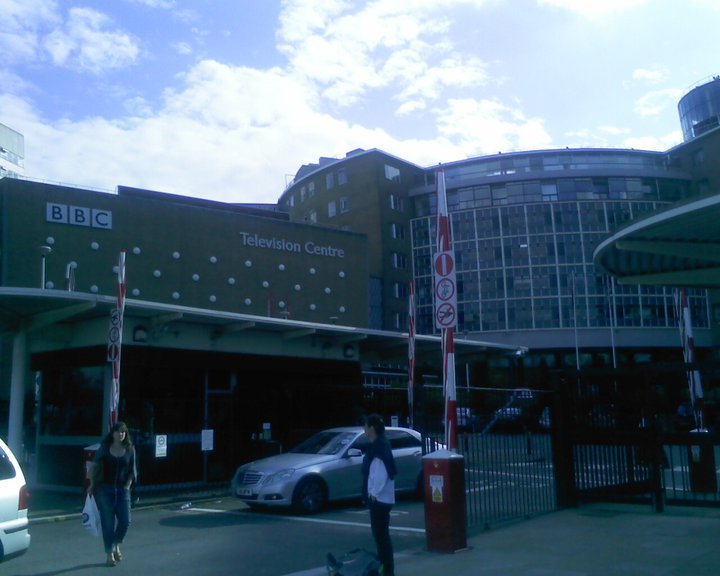 BBC Director General and ‘editor-in-chief’, George Entwistle resigned from his post following a string of mistakes during his time in positions of authority. Of all the news stories you would expect the BBC to break it would be one concerning a change at the top of its own corporation – but ITN got the scoop. The announcement came just seconds too late to make the BBC 9 0’clock news bulletin, which epitomises the corporation’s bad luck over recent weeks.
The decision came after the BBC themselves made headlines by not airing a Newsnight interview that revealed allegations into Jimmy Savile’s paedophile past as well as airing another Newsnight programme which wrongly accused former MP, Lord McAlpine, of child abuse in a North Wales care home. The freelancing fiasco about how presenters were paid indirectly through separate companies to avoid tax wouldn’t have helped matters either.
Entwistle had been in charge for just 54 days, making him the shortest director general in BBC history. His time at the top was short and sour, rather than sweet, after being made a scapegoat to take the blame for the mistakes of others. Of course, part of his responsibility was to oversee the corporation, but a consequence of a big corporate hierarchy like the BBC’s is that the people who made the crucial mistakes will escape punishment and carry on, if not at the BBC then at another media organisation. These flaws don’t even concern good journalism – it’s common sense. Programmes about child abuse should have alarm bells ringing to be referred for checks.
However, Entwistle’s name may not have been on the Director General’s door when the root of these problems occurred but he was high enough in other positions at the corporation to have done something about it. We don’t get second chances often in life but Entwistle did when he was promoted to the top spot. Part of his role was to deal with controversy when it occurs and it’s a paradox that John Humphreys’ interview with Entwistle on Radio 4’s Today programme on the morning of his resignation probably played a part in his decision to leave. Instead of sounding like a man of authority Entwistle came across bumbling about facts, not displaying qualities of a strong leader.
The BBC’s ability to examine and interrogate themselves must be commended; this is one of the reasons why the ‘crisis’ will be resolved when the news becomes chip paper. Critical times lie ahead for one of the world’s much-loved and trusted broadcasters. Former head of BBC Worldwide, Tim Davie, takes over as ‘acting Director General’ for now. He lacks a journalistic background but also lacks involvement in any of the scandals that contributed to his predecessor’s downfall. A series of unfortunate events led to Entwistle’s resignation but this was probably the right decision in order to sustain the public’s trust in the organisation that we fund through our licence fee.
VIEW A TIMELINE OF THE RISE AND FALL OF GEORGE ENTWISTLE AS BBC DIRECTOR GENERAL HERE
 Katy Booth