Category Archives: Journalism

Lancashire County Council slash services in budget
Lancashire County Councillors voted through all proposed cuts at their annual budget meeting.
It sees £65 million slashed from services, including funding for five museums across the county, some bus routes in rural areas and other services, such as libraries.
All elected members were present in what would arguably be one of the most important meetings of the year. Labour councillor, David Borrow, began proceedings saying the budget outlined had been some of the “most difficult decisions” they have ever had to make.
Cllr Borrow said, if current spending continued, there would be no reserves left to be used in emergency situations, by the 2018/2019 budget. The Preston North West councillor said in May the cabinet had to make the decisions from working with multi-agencies. He commented that other Conservative controlled councils, such as Surrey, are not facing such financial difficulties: “Lancashire has been one of the hardest hit.”
The government’s ‘transitional fund’ has given the county £2.3 million. In comparison, Surrey has received £24 million. Hampshire gets £18 million and the Prime Minister’s home county of Oxfordshire will receive £9 million.
“There will be cuts for years to come”, Councillor Borrow said. “I know how important it is for all museums to continue.” Views and expressions of int
interest in running the facilities are being sought up until March.
It was noted that the highways budget is being looked at “which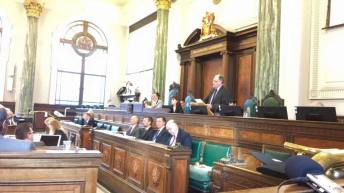 should reassure those who are the victims of the floods.” Cllr Borrow went on to say that, at the beginning of the coalition government (in 2010) spending was cut for flood defences.
Continuing to criticise the conservative government, Cllr Borrow said “the public health grant has now been cut by 1.7 million.”
[PHOTO: Councillor David Borrow addresses the chamber from the Cabinet.]
Former leader of the county councillor, Geoff Driver, was next to stand. The Preston North member was presenting an amendment of from the Conservatives to Labour’s budget plans. Cllr Driver said that, when he was in charge, the Tories left more money in the reserves than they inherited. “This administration has not helped itself”, he said. “There is a corporate strategy but no plan.”
Cllr Driver then criticised the council’s handling of turning the listed building of Preston Bus Station into a Youth Zone. Speaking of the competition to fund a new design he said: “there will be insufficient funds… It’s absolute madness!
“It’s alright saving money for a rainy day, but it’s raining now.” The Conservative budget amendment to the proposed budget mainly looked at financing services by borrowing money to fund them, rather than cutting. Councillor Graham Gooch was one of a series of members who spoke in the debate that followed. The South Ribble West representative said: “No consultations had been done before these budget decisions were made. The decisions have not been made properly.”
A lively discussion broke out with councillor John Fillis, from Skelmersdale East. It left Burnley chairperson Margaret Brindle reminding members to show respect: “This is not a bear pit”, she said.
Sitting near the back of the chamber, alongside Independent members, Lancashire’s only Green Party councillor, Gina Dowding from Lancaster, said: “The government’s financial settlement did not give us any more money.” Cllr Dowding gave an example of the Public Health cuts earlier announced. “[Chancellor] George Osbourne plans for a ‘Northern Powerhouse’. Here in Lancashire, he’s only focusing on Northern workhouses.”
Liberal Democrat, David Whipp, of West Craven spoke next. He said his party propose a “cushion” to allow the “cuts to library services to evolve.” He said he has “issues with axing the parish bus initiative” and the Lib Dems approach the budget with ‘compassion and compromise’.”
“I haven’t met with any conservatives [about the budget] then they trot this out at the last minute. Well, we won’t be supporting it”, Cllr Whipp said. The chamber voted on the Conservative amendment and the motion was lost on an eight vote margin.
The Liberal Democrats then proposed their amendment and councillors voted against that also. However, all Conservative councillors abstained. Tory Councillor Paul White, of Pendle East, commented on how his party should “commend [the Lib Dems] for having the same aims [as them]”, even though they chose to propose it differently.”
Independents and the one Green member were next to propose their amendment. They suggested a further £3 million contingency to be made available from the reserves to facilitate the transition of services. As well as cross party cabinet groups be set up to explore and support the transition of services and arrangements. This motion was passed, despite 34 members abstaining.
Next up was a proposal on bus subsidies by the Conservatives, focusing on reinstating transport to day-centres. They planned to do this again by borrowing, rather than using budget reserves or charging. Their proposals included green energy plans and under-spending on concessionary travel. This was the motion that had the most support from the public gallery, with protesters from Chipping and Ribchester staying on to find out the result.
Tory councillor, Michael Green, representing Leyland, said: “Cutting bus services attack the most vulnerable people in society; those who can’t afford to run a car, unlike most of us who will drive our cars home tonight. It is an attack on the elderly, who can no longer drive. It’s an attack on young people, who catch the bus to get to college or an apprenticeship. It’s also an attack on town centres that will lose out on business because of these cuts.”
Labour’s David Borrow said: “We have barely enough funds to deliver statutory services. Can we afford the 4.5 million of this service? We are pretending to ourselves and those in the public gallery. Some of things we have to cut [in this budget] are horrendous. We need to give the council a fighting chance.”
A tight vote 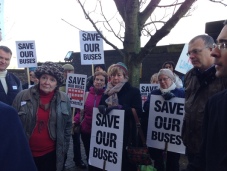 on bus subsidies followed. 40 councillors voted for the motion, 42 were against and one person abstained. Therefore, the motion was lost on a slim margin of two votes. That means some bus routes will now no longer operate. Residents of the Ribble Valley, could see a reduction in services by next week.
[PHOTO: Bus campaigners protest before the meeting.]
Councillor Michael Green gave the next Conservative amendment. He mentioned he thought the previous bus subsidy would be passed, which explains the focus of their next proposal. He wanted to see £500,000 for waste services that are not needed in East Lancashire be invested back into highways. Cllr Green said: “in the grand scheme of the budget, £500,000 is not actually a lot of money.”
Labour’s Councillor Borrow said he: “can’t see any reason to oppose this amendment.” He spoke about when he goes back home in Yorkshire he can see the roads get worse and that Lancashire should be proud of the state of the highways. The motion was voted for unanimously, although Labour’s Cllr John Filis did shout: “Why not give it to the bus people?” during the discussion.
Entering the seventh hour of the meeting, the last vote of the night was whether the budget cuts would happen. The chamber broke out into passionate debate from members. Leader of Lancashire County Council, Jennifer Mein of Preston, stood to tell members she understands it’s late in the day but she was “ashamed and appalled” by members’ behaviour when discussions got heated.
The budget was agreed and passed by councillors, meaning all proposed cuts to services now intend to be carried out.
(My article was first published on The Bee and 2BR‘s websites and is kindly re-blogged here with permission.)
Journalism – a class of its own?
The essence of a journalist in a nutshell is to report news. Think of where news is generated; the possibilities are endless. News – whether it’s good or bad – can spring up from any situation. Granted, the chance of a newsworthy story increases for people in the public eye but a bulletin doesn’t have to resemble who’s on Jonathan Ross’ chat show sofa because it’s important that ordinary voices are heard and their stories are told too. In fact, those are often the most interesting.
In order to tell these stories appropriately, we need a diverse range of journalists who hail from a variety of backgrounds. This is so important for many reasons, including empathy with a interviewee, a range of contacts and knowing where to look – having a good nose for a story.
The problem with the industry at the moment is that the amount of diversity on offer is grately restricted and that’s because the most tried and tested way in is through the education system. It doesn’t matter about student loans because, at the end of the day, an undergraduate degree still costs £9,000 a year and for post-grads, the cost varies uni to uni, but it’ll be around the £5,000 mark for a year, without the same amount of student loan support available.
It’s a massive commitment to make when you decide you want to be a journo but it sorts out the wheat from the chaff because it’s a lot of time and money to spend pursuing a dream career. Which is why I would always recommend a budding journalist do what I did and get as much hands-on experience as possible before deciding which direction to take.
I stand by the comment I made on Twitter earlier this month…
https://twitter.com/katybooth/statuses/419845712386736128
Citizen journalism has it’s place but, if you want to make this a profession rather than a hobby, you need to be an accredited journalist before you can even think about applying for certain jobs. That’s for a reason because media law knowledge is vital in keeping any work accurate and trustworthy – two key qualities of a good journalist. You wouldn’t call someone a Doctor because they can open a bottle of Calpol and it shouldn’t be a parallel in journalism.
However, I appreciate the price tag of the education system can be very elitist. This is on top of needing to do a lot of unpaid work-experience to learn your craft, so you need to be able to support yourself somehow. As well as knowing how to drive and having your own car available, which is all very desirable, on top of enthusiasm and dedication to the craft.
I’m not saying it’s right or wrong – it’s just how the industry is. In order to become a journalist, education and subject knowledge is important because you need to be able to write well. Even if you’re a broadcast journalist, phonetic spellings akin to that of text talk belong in pronunciation brackets, not your script. You will also have to write web stories online increasingly as the digital world around us continues to evolve too. That’s all on top of probably the most essential skill – you need to be a good communicator.
There is a light at the end of this academic tunnel though and on-the-job training seems to be on the rise. As I’ve written in previous blog posts, I wouldn’t change my journalism training at UCLan for the world; I learnt so much there, made great friends and found myself as a person. Although, I’m like the idea of work while you learn schemes increasing because they aim to attract a diverse range of people to the journalism profession vocationally and that therefore allows more stories to be heard.
The BBC run the Journalism Trainee Scheme and ITV have announced their Break into News initiative. Student, community and hospital radio also rightly deserve their place as excellent training grounds and I’m one of many journalists who cut their teeth that way. The Journalism Diversity Fund is also available to help with fees for those who want to access the academic route.
Let’s focus on attracting diverse journalists into the profession with a wide range of life experiences that reflect the stories we want to tell because the audience want to hear them – in an engaging and trustworthy way. That’s how we become top of the class.
Results day – the end of academia and onto a new start
Today students across the country got their A Level results but it’s been 6 years since I opened my sealed envelope from Parrs Wood Sixth Form college in Didsbury. It meant I was off to study a combined studies degree of English Language, Linguistics and Film Studies at The University of Manchester. From that moment, my life’s direction had been decided… I just didn’t realise it back then.
I’m writing this to say whatever academic results you achieve, whether they’re good or not quite what you hoped, it should not stop you from achieving your dreams. My graduation was bittersweet; I was the first person in my family to go to university, so my parents were thrilled, but I wished I had done better. I was disappointed because I achieved excellent A Level and GCSEs results but didn’t feel I was leaving university with a grade that reflected my true ability.
 The reason I didn’t do as well as I hoped was actually because I was spending too much time in radio studios! Ironically, this would eventually work out to my advantage. I didn’t enjoy the subject I was studying and couldn’t see the point if it wasn’t going to correlate with my career ambitions of working in media.
A university tutor told me that I would never be able to go on to study a masters… how wrong she was! This comment initially put me off applying for postgraduate study at UCLan but course leader, Caroline Hawtin, saw I had potential with my range of experience. (Spending all that time in radio studios WAS worth it after all!) Hopefully, anyone who knows me will know I’m completely dedicated to my career and was delighted to be offered a place on the broadcast journalism MA.
I took a chance coming out of working in the media industry to go back into further study, but enrolling was one of the best decisions I have ever made! I achieved distinctions for all my TV and radio practical work and digital modules, with merits for everything else. This shows that anyone can do well when you get the opportunity to study subjects you enjoy. That’s what made the difference to me and I appreciated my time at UCLan all the more because of it.
I still look back at my undergraduate degree at Manchester with fondness though. Academically, the course wasn’t right for me but without being there I would never have been bitten by the radio bug, by getting involved with student radio. This therefore wouldn’t have led me to qualifying as an accredited broadcast journalist. Maybe things do happen for reason?
Academic results, whether they’re good or bad, are only black ink on white paper – they can’t convey the true colour of what someone is like. Ultimately, they can only take you so far; it’s what you do after you open the envelope that really counts…
Are journalists public enemy number one?
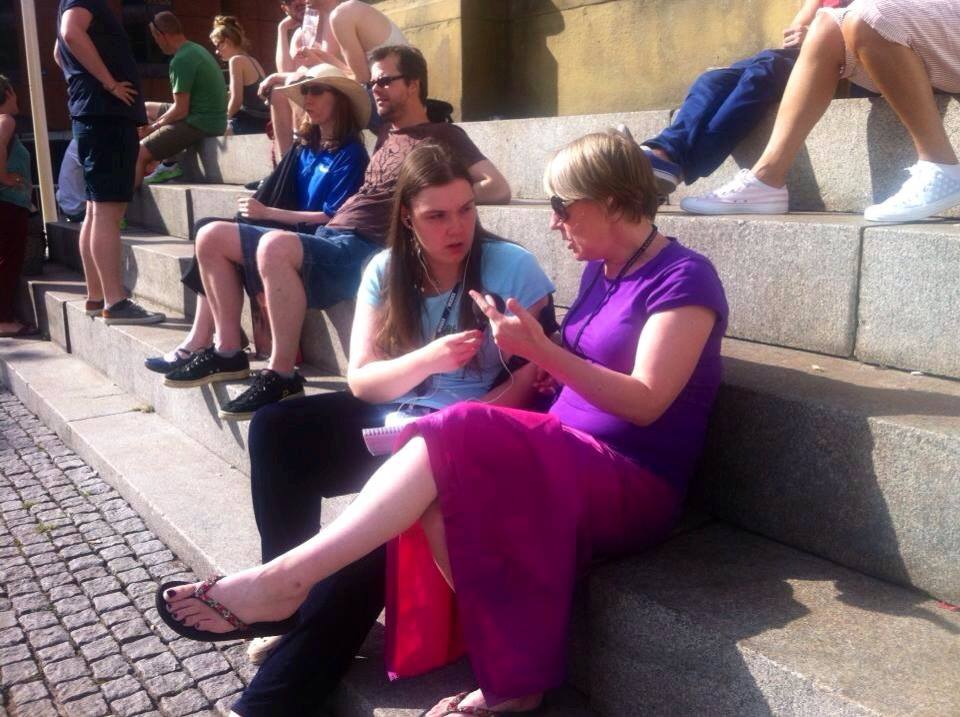
There are some professions that set eyes rolling when you mention them: traffic wardens, tax inspectors… journalists?? Yes, in my experience, all of the above apply.When people ask me what my job is – I’m proud to say I’m a journalist! Now I’ve finished my training, I’ve been working in broadcast newsrooms across the North West. It’s been a learning curve to see the general reactions when I’m out on the road roving reporting.
I love the variety of my job – everyday is different! However, I’ve noticed a pattern that often emerges; I could be chatting to an interviewee as normal, but as soon as my recording equipment is switched on their whole demeanor changes. Some will become tense, sweat beads start forming on their brow and they become fidgety. Now, to a journalist, this gives off non-verbal signals that something’s not right.
When this sort of anxious reaction happens, I get the feeling a lot of people think I’m there to catch them out – but there’s no trick questions on my list. ‘Reporter’, does what it says on the tin; we want to report on what is happening for the story we are covering. Of course, I will ask interviewees challenging questions, when necessary – but if interviewees have nothing to hide then they have nothing to worry about, surely?
Maybe I’m over analysing, because I’m so comfortable in front of microphones and cameras. Sometimes, I need to take a reality check and realise that not everybody is like me. These could be nervous reactions from people who are not used to media attention. It doesn’t explain press officers who become incredibly controlling though. In fact, that just makes me want to find out even more what they might be trying to hide…
It would seem some people are sceptical of us, rather than the other way around. Recently, I had been questioning someone about facts and figures – quite a routine interview. This was a very hot day and I hadn’t been drinking enough water. Sod’s law being what it is, I started having a coughing fit during the interview. I was behind the camera and managed to muffle any kind of noise; no one watching would have known any different – but I must have been pulling some funny faces! The guy accused me of “trying to put him off”. I would never knowingly do that. It just shows how defensive some people can be.
I think events leading to the Leveson inquiry hasn’t helped the image of journalism – but it’s important to remember that inquiry was about print journalism NOT broadcast. The mediums are different; firstly, we are regulated by the Ofcom code. Secondly, there is no agenda; there’s not a weighted political bias in broadcast journalism. We have to report stories objectively, fully attributing quotes.
Attribution is easy to do on radio and TV because you will see or hear the person saying it or it will be quoted directly. Misrepresentation is unethical and it’s hard for broadcast journalists to misrepresent someone – because proof of what was said will be on a recording.
Journalists are searching for the truth, by asking the questions that the public want – and deserve – to know the answers to. We investigate and we we hold people in positions of authority to account. Just think what might be going on in the world without journalists? Having said that, not every interview I do needs to be an interrogation… if the interviewee has nothing to hide.
Broadcast journalists are not to the enemy. In fact, maybe any interviewee who thinks we are should try looking in the mirror?
Emotion in journalism
I won’t apologise for feeling emotions about particularly moving news stories. I couldn’t change the way I am anyway, nor would I want to. I’ve met journalists who feel differently about this; some think if you’re covering a story then you should detach from the emotion involved. My own view is that I think it makes me a better reporter, giving me a better understanding of events if connect with stories on an emotional level. The audience are going to have these empathetic feelings too, so it makes sense that a journalist should be in tune with this – the audience are the people we are creating the news output for.
 Each day there are stories in the news that can affect us in this way but the murder of soldier Lee Rigby in Woolwich is one that has flared up public opinions across the country, from the London borough where it happened to his hometown of Middleton in the North-West. A man who had survived the warzone in Afghanistan was murdered on a British street.
Part of the reason why this gained so much prevalence is because the media broadcast or print it. There are no right or wrong answers to the argument as to whether images of terrorism like this should be reported. On one hand, people want to know what’s going on in the world and censorship would water down the, sometimes unpalatable, realism that goes on.
The other side is that it can be seen as gratuitous, just because it’s a big story doesn’t mean we lose taste and decency. This isn’t a film that’s being shown – it’s real life. It’s hard for parents to keep track of too; children may access the images easily in newsagents, on TV channels and the internet, particularly social media and the backlash the news coverage has caused for Muslim communities is a negative example of this.
In terrorism cases, the media gives attackers a mouthpiece for their message to reach (and frighten) more people than it ever could have otherwise, which is essentially giving them what they want. The Woolwich attack suspects were heard asking for onlookers to film them after the attack, proving that point entirely.
My view is that these events need to be reported – the whole point of news is that we cover current events – we don’t want to wrap society in cotton wool either. However, I do feel there needs to be a line on how graphic this coverage needs to be. I know I’ve written about this before in my post about the Boston marathon bomb coverage, but I don’t mind saying it again. Unless we speak openly about this nothing will change. It is important to identify the people who did this, there’s no reason why they deserve anonymity after such acts of violence other than to prevent false accusations on who the attackers are. (This is not an issue in the Woolwich case.) But do we really need to see their bloodied hands? Even a description of that is graphic enough.
Personally, I feel it is disrespectful to to show images of a dead body to the victim’s memory, as well as their loved ones to have to see. It is poignant enough just seeing the photos of him in his soldier drummer uniform, anything else seems unnecessary to me.
It goes without saying that any news coverage should be reported objectively but human interest elements are what make the public want to hear news. I’m not a fan of sensationalism either – so emotion should be kept out of news reports as much as possible too – particularly in broadcast media. That’s not to say that journalists can’t have feelings when the cameras and microphones are switched off; we are all human after all.
Top of the Vox Pops
Definition: VOX POP (Vox Populi) –“Voice of the people”
A vox pop is an interview with members of the public; their answers about a particular topic are usually edited to give snippets in succession. I’ve learnt lots by doing this over the years, so thought I would share what works best for me…
- Ask open questions!!
If you only remember one thing from this post then let it be this: Asking open questions is the most important thing you more do when you vox pop. Here’s an example:
CLOSED QUESTION: Do you agree with XXX?
OPEN QUESTION: What’s your opinions on XXX?
Open questions elicit expansive answers from people. There’s nothing more boring to listen to than a series of yes and no answers – we’re not playing Take Your Pick!
- Use station branding wherever possible.
This is almost like a form of ID and people will be comfortable speaking to you if they are familiar with the station you are doing the vox pops for.
- Approach people within the station’s demographic or target audience.
…But make sure the selection of people you speak to are diverse enough to give a true wide reflection of society’s opinions on a given topic.
- Target areas with a high amount of footfall.
You will get your work done quicker if you does this; more people around means you’re more likely to get a response. However, avoid places where there is a lot of flyering because people will have become used to saying no in these areas.
- Keep off private property.
Some areas, like shopping centres and train stations, are privately owned and you will need permission to vox pop here.
- When speaking to members of the public, who may be in a rush, walk alongside them.
This way they won’t have to stop and take time out of their day to talk to you, so you’re more likely to get a response.
- If someone says no then leave them.
Do not harass or beg someone to speak to you – someone else will come along who will. The same applies if someone ignores you; they’re doing this on purpose.
- Press record BEFORE you ask the question.
That way their response will be genuine. People are naturally curious and will often ask what you are going to ask them before they agree to speak to you. Avoid doing this as it ruins spontaneity, if they are not happy with anything then you don’t have to broadcast it and can always delete it.
- Always wear earphones (or headphones) to monitor the sound.
You will pick up noises or interference through earphones that your ears would not. Earphones are usually better when vox popping, as they are more portable.
- Keep an eye on the level monitor.
That’s a better indication of volume than what you can hear.
- Always use a pop screen or windshield on the microphone.
Do this even when indoors as a force of habit. Plosive consonants – particularly P, T and K – can produce irritating popping sounds, so a foam layer on the microphone reduces that risk. On windy days even a windshield won’t save you. In this case you’ll have to be creative with scarfs, coats, gloves – anything that will deaden the sound of wind hitting the mic.
- Keep safe!
Last but certainly not least! When you are immersed in your work it can be easy to take your eye off the ball. The equipment you’re carrying automatically makes you a target of unwanted attention in public places, so keep alert and an awareness of your surroundings at all times.
Keeping it Real
 My radio placement was over the other side of MediaCity with the Real and Smooth network. For a radio fan like me this was a great to work in a news hub that served a network of three stations, Smooth Radio (national), Real Radio (North West) and Real XS (Manchester). As is the unpredictable nature of news, during my time on placement a lot stories that got massive national media coverage broke on our North West patch.
As you’ll know from my post about my placement with BBC North West Tonight, this is a reflection of the work I did on placement rather than a recount of the news – you can access that in many places on the web, I’ll link to the stories. In these posts, I want to offer a different perspective through my eyes as a reporter…
MICHAEL AND HILLARY BREWER SENTENCED FOR SEXUAL ABUSE AT CHEETHAM’S SCHOOL OF MUSIC
I got my first taste of a media frenzy outside court after the sentencing of Michael and Hillary Brewer, who were charged with sex offences, mostly occurring while he was a teacher at Cheetham’s School of Music in Manchester. This case had got attention because of of the victims, Frances Andrade, took her life during the trial. Atmosphere outside of court was tense as the media eagerly awaited the statement from the Crown Prosecution Service.
The cameras were in place well before but radio reporters have to think quickly to get in a good position when speakers come out so that they can be in range to get good quality audio on the microphones. I did well to get right at the front, which not only meant that Real Radio got good brand placement for the cameras but also that my hand was seen on all the TV news channels that day. I’m now in a strange situation where my purple coat is more famous than I am!
DOG ATTACK THAT KILLED JADE ANDERSON IN ATHERTON
 No matter how much training you have beforehand, nothing can prepare you emotionally for some of the stories that you will have to cover as a journalist. The day started out like any other, I was out vox popping a light story in the morning but then I got the call to go on to Atherton, near Wigan, to cover the story on Jade Anderson – a 14 year old girl who had been mauled to death by pitbull type dogs. Like the flick of a light switch, the tone of the work had changed and was now incredibly sombre.
When I got to the crime scene I had never heard a silence like it; despite there being so much activity from media attention to people coming to pay their respects – there was no noise to be heard on the estatem other than a lone dog barking in the distance. Very haunting.
STEPHEN SEDDON GIVEN A LIFE SENTENCE FOR MURDERING HIS PARENTS
I had been following the Stephen Seddon trial while working with BBC North West Tonight and was in court reporting on his sentencing. Sedddon was found guilty for murdering both his parents. The judge, Mr Justice Hemblem, said the motive was for their inheritance money. Seddon’s sentence also included attempting to murder his parents earlier in the year by driving them into a canal.
Courtrooms feel very theatrical, maybe I have been watching too many legal dramas, but the atmosphere really was intense. To look directly at a man who has been sentenced to life imprisonment from the press box is a rare opportunity to have. It’s dramatic enough hearing about such cases on the news, but to actually be there to hear him sent down in person is something else. I was absorbing the atmosphere of the court proceedings happening around me while scribbling down notes as fast as I could – no recording devices are allowed in court. However, the judge’s words were so powerful, alongside Seddon’s own outbursts and last pleas of innocence, that I can still remember much of what was said in there verbatim, even now.

I covered lots of stories during my time on placement with Real, from the abolition of Legal Aid in some situations to Stockport being voted the second happiest place to live in Britain. (Yes, really!!) By far those that I’ve mentioned in this post are the news stories that stick in my mind most potently though. It was a joy to work with the team whose bulletins I’ve listened to for many years on a network of stations that I am a fan of. Not only was that an amazing experience in itself but I learnt so much while I was there too and my copy writing skills are well up to broadcast standard. Hearing scripts I had written be read in bulletins was amazing – I loved working in such a buzzing newsroom! My placements have given me the taste of what working life will be like when I graduate from my masters and I take all those valuable experiences forward with me now I’m applying for freelance work.
BBC North West Tonight
 When I tell people I did my TV work placement with the BBC North West Tonight regional news programme I usually hear something like “but we didn’t see you on TV!” That’s beside the point really; screen time on any TV programme only accounts for what viewers see. There’s a whole team working hard behind the scenes to get content to air as smoothly as possible – I loved being part of it!
There would be so much to mention about time working on the programme, and alongside so many talented journalists, but then it would become more of a epilogue than a blog post – so this will have to be a whistle-stop tour. (In no particular order, terms and conditions apply… Oops! Didn’t need the bit about T&Cs!) Here we go…
HEART SCREENINGS IN MEMORY OF JOHN MARSHALL
Having footage I shot myself air on the North West bulletins during BBC Breakfast was an honour. My footage was shown after interviewing the family of John Marshall, who died suddenly from an undiagnosed heart condition 18 years ago. His family were holding a screening session at Edge Hill University as part of their campaign for heart screenings to become more widespread and to raise awareness of heart conditions affecting young people.
NEW DRUG APPROVED TO FIGHT BREAST CANCER
A drug called Perjeta had been granted licence for use in Europe; it prolongs the lives of some breast cancer patients by over 6 months. Although not yet available through NHS treatment, the drug has been trialled by The Christie in Manchester – I was going to interview a doctor about their findings. Case studies are what illustrate news best and when I got there I was able to talk to someone who had experience of using the drug. As this was all very spontaneous I was about to do my most emotional interview to date with no preparation! This is where my initiative journalistic skills came in and I was able to come back to the newsroom with poignant footage used in a big screen presentation by NWT health correspondent, Nina Warhurst.

APPEAL TO FIND ANDREW JONES’ KILLER
Andrew Jones was killed in 2003 after injuries sustained after falling to the ground from a single punch. 10 years on and his parents, Christine and Andy, were appealing for anyone with information to speak out. I interviewed them at Merseyside Police Headquarters ahead of their weekend vigil. I found out the embargo had been lifted on this story while there and after relaying the messages to producers my work featured in Dave Guest’s top story for the lunchtime and evening programmes.
 THE ARCHBISHOP OF LIVERPOOL’S RESIGNATION
One of the last official duties that Pope Benedict XVI had to approve was the resignation of Liverpool’s Archbishop Kelly. I spoke to him at the Metropolitan Cathedral in Liverpool and helped film one of his last masses in tribute to the outgoing Pope that featured on the late bulletin.
COMIC RELIEF
It was a privilege to be on placement with the BBC during Comic Relief . I particularly enjoyed helping Carol Lowe film her report on how some of the money was being used in the North West at Stick ‘n’ Step. A charity helping children with Cerebral Palsy, in Wallasey. I also got to shoot footage of what was happening to fundraise around MediaCity. Particular highlights of mine were the Bake-Off, Harlem Shake out on the piazza and the Zumba-thon in Liverpool, all of which I filmed and were shown in the North-West opt-out during the evening’s main Comic Relief programme.
LAUNCH OF MANCHESTER INTERNATIONAL FESTIVAL 2013
 Eno Eruotor and I went to the press launch of this year’s MIF, we heard about what was to come in the festival, which featured an appearance from Shakespearean actor Kenneth Brannagh! He wasn’t giving any interviews (and at that point he didn’t even know I was in control of the lighting!!) but we did speak to one of my favourite actresses, Maxine Peake. She gave me a bit of competition for being NWT’s biggest fan too!
Sadly, I can’t cover everything that happened on my placement or mention everyone, but those are the main things I talk about when people ask me about my placement. Thanks to all the NWT team for making me feel so welcome, trusting me with their content and giving me a TV placement I will never forget!
My next blog post will be about my radio placement with Real Radio… Stay tuned!

Looking through a lens at the Boston Marathon
Breaking news can cause a surge in social media visits as people all over the world feed their hunger for the latest information. This applies to any major news event or tragedy but I’m going to focus on the most recent, which is the aftermath of the explosions at the Boston Marathon.
I looked at social media myself to see the updates and near enough every tweet contained something about Boston. Tributes and opinions alike flooded my timelines – but instead of moving me I found it unsettling.
Trying to squeeze my thoughts into 140 characters, I posted this tweet:
https://twitter.com/katybooth/status/323916002624688128
I had such a big response, and a wave of new followers off the back of it, that I wanted to expand here in my blog. I have a problem with the voyeuristic images that I was bombarded with, whether I wanted to see them or not. Apparently, as news consumers, we ‘need’ to see images of devastation like that. Fair enough, the blasts were shocking. Do we really need to see images of the injured at what is perhaps the most vulnerable time of their lives?
In my view, ethics should come before sensationalism. In the UK, the law states that people should have a “reasonable expectation of privacy” and this would be most applicable in times of extreme tragedy and heartache. Yet, I could see the torture on the faces of people whose legs had been blown off being stretchered away. I doubt they had given their consent to that. It brings up the debate as to whether a person surrenders their right to privacy for being involuntarily caught up in a news story for the sake of ‘good pictures’ or whether their right to privacy should be respected by journalists.
Just because technology makes it available doesn’t necessarily make it right. Maybe it’s because our culture is used to the blood and gore seen in films and video games – but this is real life. I think it reflects our sadistic society; devastation could still be conveyed by censoring someone’s identity, not ideal but it’s a compromise.
It’s not to say I agree with it, but I can understand why news corporations broadcast and print these contentious images. The knock-on affect of this is that the images can then be copied and manipulated by the general public and posted to their social media profiles, on the likes of Twitter and Facebook. In their defence, many may feel it’s a tribute to post their blessings next to a photo of a wounded runner. Personally, I find it disrespectful and an invasion of privacy into the life of someone they have never met.
Anyone with a camera and a wi-fi connection can now be a reporter, but perhaps more worryingly, is that anyone with a keyboard and an opinion thinks they can be a citizen journalist. Although, there is something fundamentally wrong in that view because any credible journalist knows it’s their duty to report, rather than speculate, about what’s happening. The people on social media trying to be citizen journalists can offer no more insight than the next person sat gazing gormlessly at a computer screen can. It’s the reporters at the scene who can relay the accurate information – chose your sources wisely.
I’m not condemning the support that the Internet can offer, the tributes to the victims of the Boston blasts were touching. However, this has a flip side; the Internet, particularly social media, is littered with people’s opinions that mean nothing. I’m all for freedom of speech as long as it’s informed and respectful – otherwise, why waste your breath?
Roving reports from MediaCity…
 Ever since I can remember, I’ve always wanted to work in the media industry and have been fascinated by the broadcast side of things. Starting out on student media laid the foundations for my radio work and when I graduated I was fortunate to earn a place on ITV’s Runner Pool. I was based in Leeds and at Granada working as a production assistant for factual / entertainment programmes and got a real buzz from working in such a fast paced environment. Since enrolling on UCLan’s Broadcast Journalism masters I’ve been able to create content for all broadcast mediums, as well as learm a new journalistic skill. Now I’m looking forward to beginning the courses’ BJTC work placement period with the BBC at MediaCity.
Any big change prompts me to get wistful about where it all began. I can remember vividly where my inspiration to work in media comes from – it goes back to when I was in primary school. My parents’ friends, Mavis and Laurie, owned a company that got commissioned to make TV sets for lots of different programmes. At the time they’d just finished the set of a new Sooty show for Blackpool Pleasure Beach. You can imagine my excitement when they said I could see Sooty’s set… Come to think of it, I’d probably still get excited about that now!
It was an amazing experience to see the sets I’d seen on TV in front of my eyes. As we walked along the shopfloor I did get to see Sooty’s new lodgings, alongside a fascia from Coronation Street’s Rovers Return and Gordon Burn’s new North West Tonight desk. When the show got re-branded there was the desk that Laurie had made on the screen! I’ve been a fan of NWT ever since. I love regional news and have watched the programme for years, so I think it must go back to that moment.
It’s been great to have been taught by a producer and cameraman from NWT while at UCLan. The packages that I’ve filmed for our news days are all available for you to watch on my YouTube channel. To quote Blue Peter – here’s one I made earlier! It’s my latest TV report about the Book Cycle project in Wigan…
More of my reports are available my YouTube channel: youtube.com/katybooth
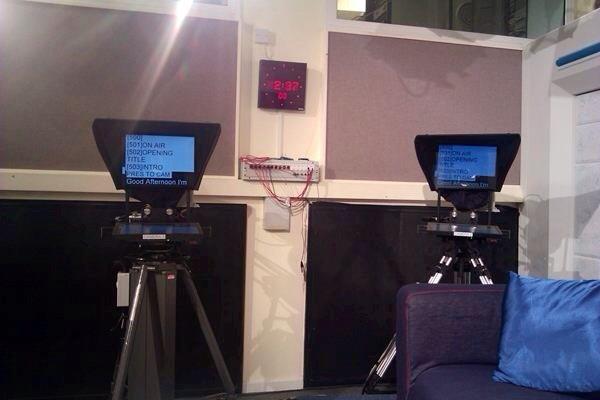 I’ve enjoyed both our UCLan radio and TV news days, where we got the chance to broadcast news bulletins for both mediums as well as creating web content. I already had a lot of radio experience prior to joining the course but it’s definitely sharpened my skills and the voice training has been beneficial – especially in getting, what the vocal coach described as, my “lazy tongue” into shape!
I learnt new skills as well as lots about myself with our TV news days too I can now self shoot my own reports. This was an ambition of mine and I’m glad that I can say I’ve achieved this and can put it on my CV. Having made my own videos for years with a camcorder it’s been good to learn how to professionally edit reports too. These are all skills that I will be using on my work placement with BBC North West Tonight. The news desk that I saw and even the studios where the programme broadcasts from have changed over the years but I’ve watched the programme throughout, so it will be a privilege to spend my placement with the NWT team.
Maybe one day I’ll be able to sign off with my own standard out cue, but until then here’s a photo from our course trip to MediaCity…
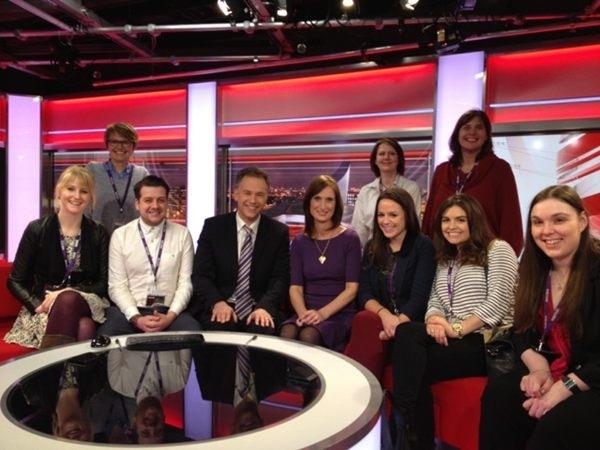
The post-grads on our trip to BBC North West Tonight with Roger Johnson and Annabel Tiffin
 Katy Booth